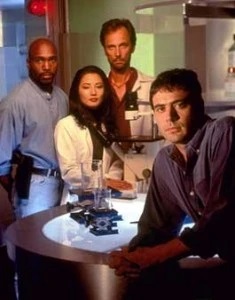
"As you might well expect, critics were not particularly kind evaluating this genre series. Writing for The Skeptical Inquirer in May-June of 1998, Peter Huston observed that the series made him “want to throw shoes at the television” and noted that it featured “Snarly fashion-model scientists chasing intelligent hive-mind vampire zombie viruses with flame throwers.”
And yes, that may be the best line ever written in a TV review."
Read the whole thing here:
Cult-TV Flashback: The Burning Zone (1996 – 1997)
For some time, many skeptics have complained about the lack of scientists shown on TV. Why doesn't someone create a television series in which scientists are shown solving problems? goes the lament.
Well, as the old saying goes: Be careful what you wish for. It might come true! The United Paramount Network has released a new series called The Burning Zone. "Torn from today's headlines, UPN'S 'The Burning Zone' mixes science fact and science fiction," or so claims the advertising. Each weeklyadventure is about an "elite bio-crisis team," founded by "the chief of a top secret chemical and biological task force." The team's continuing mission is to offer an immediate scientific response to outbreaks of new diseases. Surely, such a premise sounds promising to those who wish a boost for science, medicine, and science education. But don't get too happy too soon.
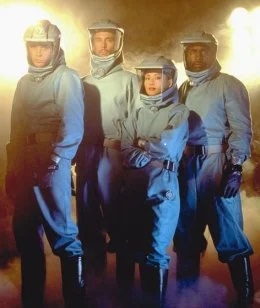
In fact, The Burning Zone has more in common with that morally enigmatic media cliche\ "the cop who can't work within the system," than it does with the actual world of real-life science and medicine. The leader of the "task force," Dr. Edward Marcase (played by Jeffrey Dean Morgan), is "a brilliant young virologist." Yet he's a virologist who can't work within the system. While cop shows often delight in police who break rules and trample on the constitution they've sworn to uphold, here we are offered a doctor who tramples on the scientific method, a system of reasoning by which he is expected to prove his results.
The publicity materials describe Marcase as "among the best scientific minds fighting the viral war—but he also has a bent towards the mystical . . .For Marcase, science cannot always fully explain the things he has seen. He often finds himself faced with a crisis on the outer edges of medical science— with one part rooted firmly in the unknown." The writers and producers apparently fail to understand that science is not supposed to fully explain everything people see. It is, instead, a method by which one can attempt to explain and ultimately come to understand things. And by rejecting this method, and featuring a scientist who rejects science, the show's producers have alienated those who normally would have been excited by a series dealing with scientists combatting deadly viruses.
In the premier episode we're treated to the handsome, yet surly, Marcase (it's the 90s—surliness is in!) driving much too fast in a convertible whose license plates say "Ebola." A state trooper begins to chase him, but rather than pull over, he speeds to the secret antivirustask-fbrce headquarters where armed guards let him in and chase off the pesky state trooper at gunpoint. In other words, a typical scientist on a typical day at a cypical lab. And, no, I am not making this up.
Marcase's boss doesn't care or even mention that he's just produced a needless armed confrontation in which someone could have been killed. After all, Marcase is a brilliant young virologist and they're, apparently, above the law. Not just human law but, as we'll soon see, scientific law. Marcase is introduced to the other members of the team. We have Dr. Kimberly Shiroma (Tamlyn Tomita), a beautiful, yet surly, molecular geneticist, and Michael Hailey (James Black), a security specialist and expert on the history of plagues. He's tough and handsome—yet surly. The members of the team scowl at each other a bit, act mean, and describe the self-destruct system in their big old house/secret headquarters/antiviral bat cave.
They go down into the basement where they've got an anthropologist plague-victim strapped to a bed in a virus-proofroom. Now lest one wonder, this particular virus seems to turn people into vampire-zombies. The virus also has a hive mind and causes people to act like possessed demoniacs with the strength of four men. . . . That's enough to give you an idea.
I contacted the publicity department at UPN, and a publicist generously returned my call. I voiced my concern as to what role a science advisor plays on a show featuring sentient viral-vampirezombies. She said the use of a scientific consultant allows them to do scientifically oriented shows as they wish, but that will not always be a concern. "Besides," she stated, "how can anyone really say whether viruses are intelligent or not?" The publicist said she'd fax me the eighteen-page transcript of the prebroadcast publicity press conference.
From the transcript, it is obvious that the producers and writers think they can insert science into the show whenever they feel like it. The actors describe scientists as "eggheads" and "brainiacs" during the press conference. One voices his strong belief in UFOs and the impending changes coming with the advent of the millennium. Viruses, the producers state, are used as a metaphor for evil. Apparently, real viruses are not enough of a threat in themselves—they are more dramatic as a metaphor for something else. Throughout it all, perplexingly, the producers hope that the show will somehow inspire young people to "become virologists." Nice thought, but I must ask how.
As I try to find something positive to say about the show, all I can come up with is that Tamlyn Tomita is an attractive woman (even if she is being surly). But the problem isn't that UPN put a bad show on the air. They've done that before, several times. (In fact, this show followed Homeboys in Outer Space, another televised disaster.) Furthermore, I think it's safe to predict that by the time this reaches print, the show will either be canceled or radically revised. The problem is that someday somebody's going to come along and say, "Why aren't there any shows about scientists on TV?" And UPN's answer will be, "We tried that once. We put on a show called The Burning Zone. It was about scientists who tried to cure viruses. Scientists curing viruses is an intellectual concept, right? Nobody watched it. People don't watch intellectual shows about scientists." And they'll miss the point. People won't watch The Burning Zone because its stupid. And a stupid show featuring science is still a stupid show.
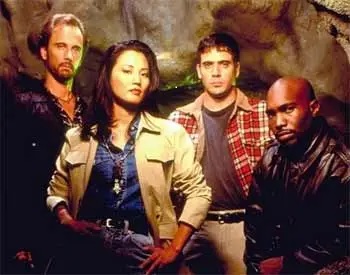
Since first writing this piece, I have caught two more episodes of The Burning Zone. The second was actually not bad and what I had originally expected from the series. The plot focused on the team's efforts to identify, understand, and safely remove a stockpile of thirty-year-old biological-warfare agents that had been created and abandoned by a mysterious secret organization. The third, unfortunately, dealt with a being (hinted to be Satan or some other supernatural demon) who spread a mind-altering virus by offering fruit ("forbidden fruit," of course) to unsuspecting people who would then become evil. Although the show has potential, I remain convinced that its writers lack the scientific and medical background to write a show about scientists battling viruses and, instead, are forced to write stories involving silly monsters. This is a shame because anyone who has ever worked in the medical field knows that real viruses can be much more frightening than any imaginary monsters
—Peter Huston
A freelance writer and former ambulance attendant, Peter Huston writes from Schenectady, New York. He is the author of two books, including the skeptical work Scams from the Great Beyond, due out in January 1997 from Paladin Press. He does like television shows featuring silly monsters, just not when they make absurd claims of being based in science fact.